Expansion Joints

Expansion joints are designed to ensure continuity between two structural elements and to follow the movements of the structure itself.
All joints have a specifically integrated water drainage system and they are designed to minimized traffic noise and to ensure the maximum comfort and safety of the transiting passengers. Our joints are compatible with § European Standards ETAG 32.


The typologies are:

MAT type reinforced rubber

Steel comb

Strip seal

Modular

Underfloor

Railway

01

All Expansion joints

One-piece reinforced rubber joints – SM

7

The SM series one-piece reinforced rubber joints consist of steel side plates vulcanized to deformable rubber elements.

The joint panel is supplied with a rubber flashing for water collection and a fastening system consisting of anchor bolts, washers, and self-locking nuts.

The joints are designed and manufactured in compliance with the international standard EAD 120110.

Composite Reinforced Rubber Joints – MEG

7

The MEG series composite reinforced rubber joints consist of a central plate covering the gap between the structural elements, vulcanized inside a rubber element.

Sliding is ensured by the presence of deformable rubber modules, vulcanized to steel plates and containing stainless steel anti-lift bars.

The sliding capacity of the joint depends on the number of rubber modules it is composed of.

The joint panel is 1.5 m long and comes with a rubber flashing for water collection and a fastening system consisting of anchoring brackets, washers, and self-locking nuts.

The joints are designed and manufactured in compliance with the international standard EAD 120110.

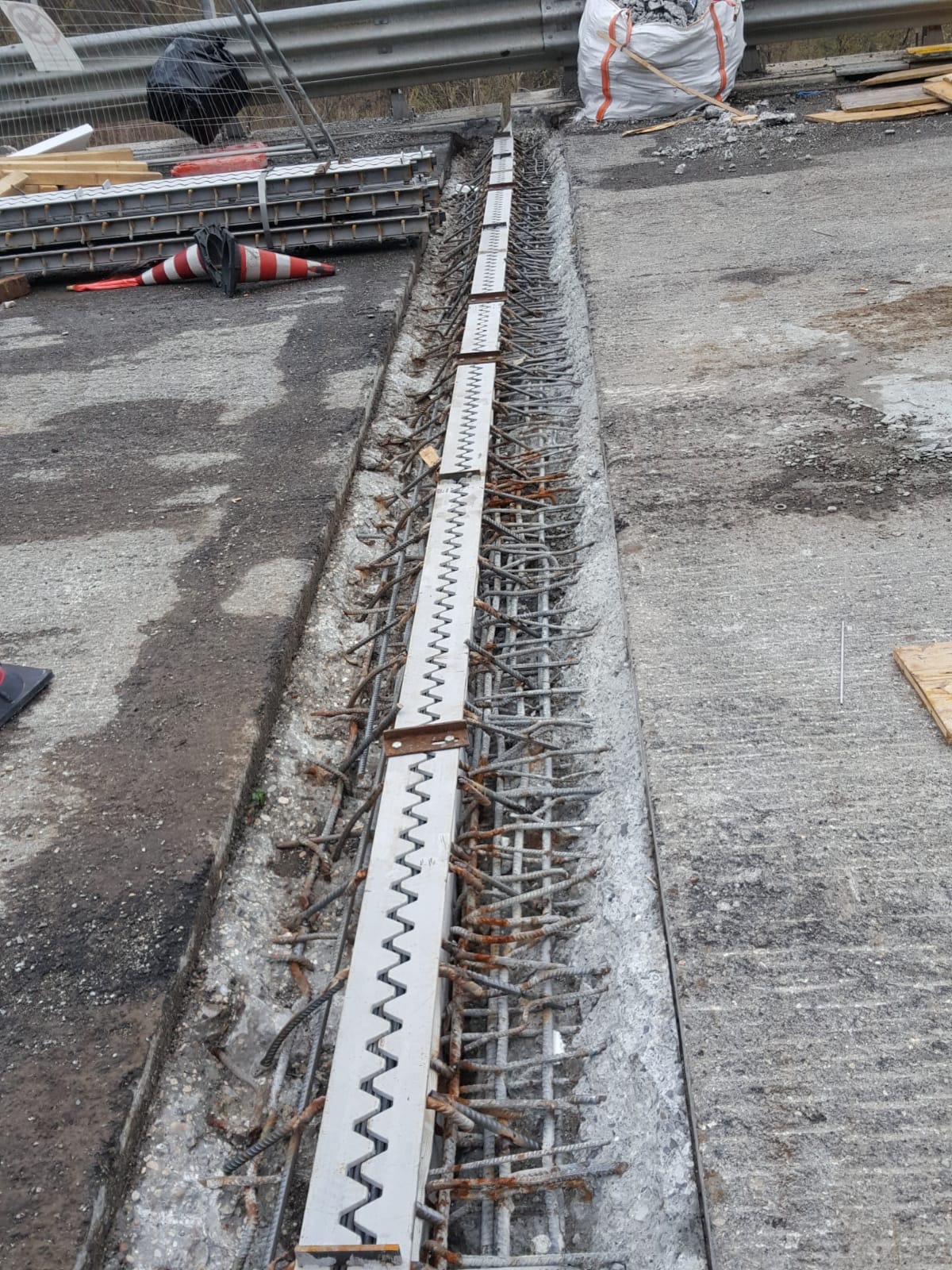
Steel and Corten finger joints – PT and PTW

7

The PT and PTW series finger joints consist of two carbon or Corten steel plates machined into a comb; the teeth of the comb are designed as brackets.

The joint is supplied with a rubber flashing for water collection and a fastening system consisting of anchor bolts, washers, and self-locking nuts.

The joints are designed and manufactured in compliance with the international standard EAD 120109.

Longitudinal reinforced rubber joints – SMV

7

The SMV series longitudinal reinforced rubber joints consist of steel side plates and a central steel bridge plate, vulcanized to deformable rubber elements. The joint surface is free of longitudinal grooves to ensure maximum comfort and safety.

The joint panel is supplied with a rubber flashing for water collection and a fastening system consisting of anchoring brackets, washers, and self-locking nuts.

The joints are designed and manufactured in compliance with the international standard EAD 120111.


Strip seal joint – TS 80-100

7

The TS 80-100 series strip seal joint allows for movements of up to 80 (±40) mm.

The joint consists of two metal profiles shaped to accommodate an elastomer gasket that ensures deformability and waterproofing. Anchoring to the slab is achieved with clamps.

The joints are designed and manufactured in compliance with international standard 120109.

Modular joints – Ts

7

The Ts series modular joints consist of an arrangement of beams that extend perpendicular to the longitudinal axis of the bridge and are interconnected by elastomer seals. The central beams, in turn, slide on support beams designed to allow translational and rotational movements.

The modular joints significantly reduce noise and vibration from road traffic and ensure a perfect seal. The components and connection systems have high fatigue strength.

The joints are designed and manufactured in compliance with the international standard EAD 120113.

Underfloor Joints – SPS

7

The SPS series underfloor joints allow for small movements and are designed for installation beneath the road surface.

The SPS series joint consists of a rubber element reinforced with a steel plate to be positioned continuously over the gap, secured at both ends to the slabs with mechanical anchors.

A flashing for water collection is included.

Railway Joints – RAILWEJ

7

The RFI-approved RAILWEJ series railway joints are designed for use on railway bridges and viaducts and meet the requirements of the RFI specifications.

Specifically, dielectric rubber is used. Anchoring is achieved using threaded stainless steel rods. A flashing for water collection is included.

The joints are designed and manufactured in compliance with the international standard EAD 120110.